
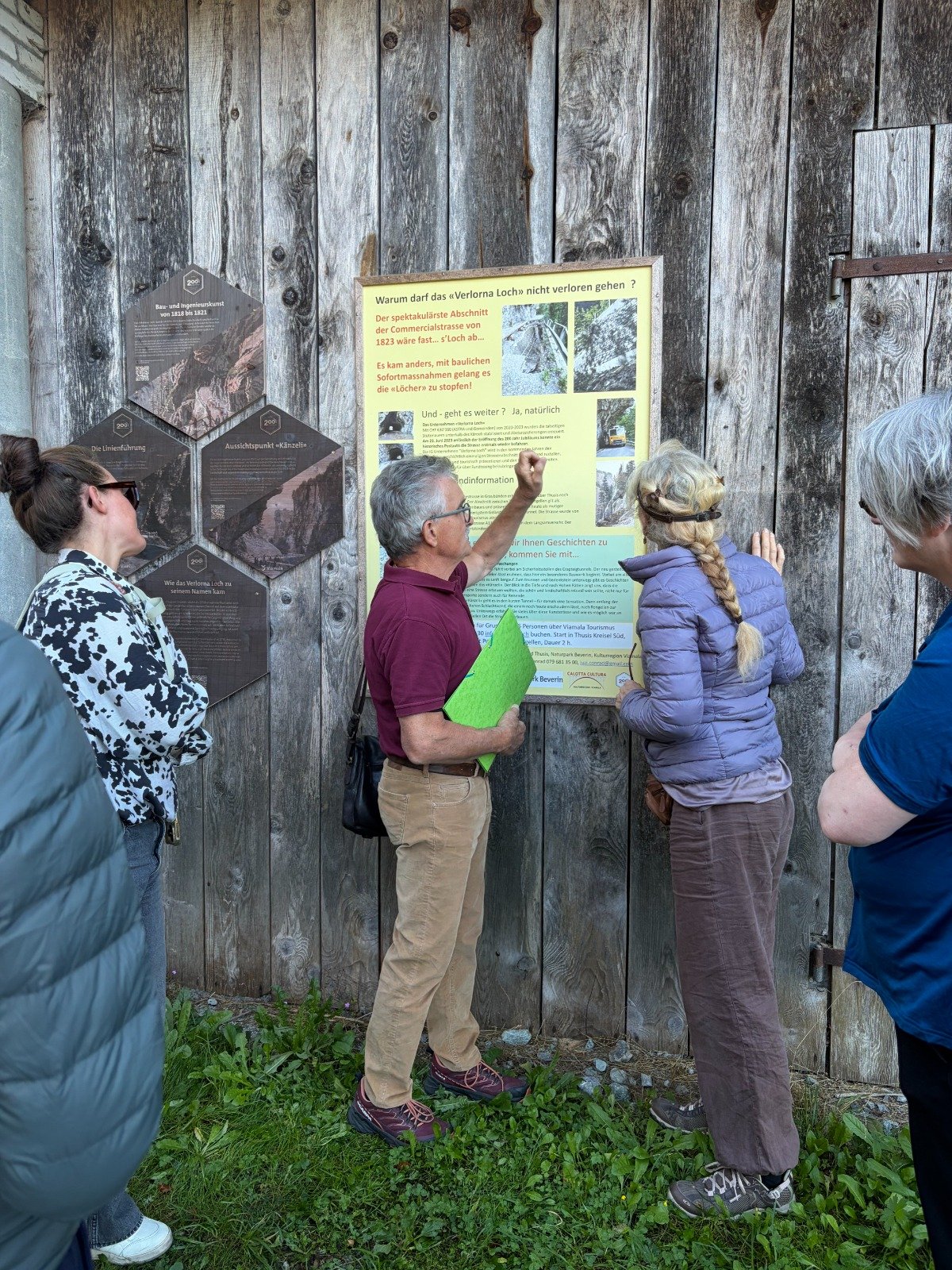
Katja Diehl is a mobility expert, author of five books and one of Europe’s leading advocates for socially just transport systems. In September, two members of the Young Mobility Network, Sarah and Tejas, joined her “Learn and Travel” delegation to Graubünden, Switzerland. Katja was our guide, together with local experts such as Remi Crameri, mayor of Thusis, and Simon Gredig, Chur City Councillor.
> You can read about the trip in our article How Mobility Works in Switzerland.
After three days and six modes of transport, we asked Katja a few questions about what we saw and about her work. Here is what she told us.
Sarah, YMN: What does Switzerland do well that others struggle to replicate?
Katja Diehl: It doesn't have one secret ingredient. It has a decision that was made decades ago and has been maintained ever since. Public transport is treated as basic infrastructure, rather than as a business that has to justify itself every year. The integrated timetable means that trains, buses and boats connect and you can rely on them. A village in Graubünden is not an afterthought in the network; it is part of the design. Voters have also repeatedly voted in favour of funding it, and that's something that other countries can't replicate by simply buying trains. It requires political continuity and the belief that the system will still be there in twenty years' time. Most countries change course with every election cycle and then wonder why nothing adds up.
Sarah, YMN: What keeps you motivated after writing five books and years of podcasting?
Katja Diehl: What keeps me going are the people who write to me and say: 'I thought I was the only one who felt left out of this system.' Mobility isn't just a technical topic; it's about who gets to participate in society. As long as that's true for so many people, I have a reason to keep talking about it.
Sarah, YMN: Why do you believe this generation will change things?
I have faith in your generation because you won't accept 'that's just how it is' as an answer. You have grown up knowing the cost of car dependency, and you are not willing to pay it forever. You also work across disciplines and borders, and that's exactly what the transition needs.
Sarah, YMN: What will a typical travel day look like in ten years' time?
If we get it right, a typical day in ten years' time will look like this: you leave the house without checking whether you have a car. Buses and trains run frequently enough that you don't need to check the timetable. You cross a street designed for eight-year-olds and eighty-year-olds, not two-tonne SUVs. Your ticket works everywhere and you only need to pay once. Your grandmother in the countryside can get to the doctor's without having to ask anyone for a lift. Nothing about it is spectacular. It's simply normal, and that's what makes it a success.
Sarah, YMN: What advice would you give to people who want to work in the mobility transition? Where are younger people needed most and which skills are undervalued?
Katja Diehl: Go where decisions are made and your age is unusual, such as municipal administrations, transport companies, planning offices and politics. Many of these places are short of staff and full of outdated routines. You can achieve more change from within than from the outside, and it's also where the mobility transition will either succeed or fail, through thousands of small decisions.
Undervalued skills:
Active listening. Talking to the people who are affected, rather than just talking about them. Communication that doesn't sound like a planning document.
Negotiating and managing conflict. Being able to say, 'I don't know the answer yet. Let's ask the people who ride the bus.'
Courage: speaking up in a meeting full of people who have done things differently for thirty years. Technical expertise is something you can learn. It's these skills that decide whether anything gets implemented.
Finally, a message for the Young Mobility Network:
“The mobility transition won’t come from above. It will come from people like you who simply start.”
Special thanks to Katja Diehl for organising and guiding the Learn & Travel delegation, and for sharing her time and ideas with us. To follow her work, visit katja-diehl.de.
Do you want to know what else we do at the Young Mobility Network? Check out our Summer Biking Tour around Europe!